
Coach Authentication
September 5, 2026 | By Vintage Icon Vault
Most people authenticate Coach backwards. They start with an app, a serial screenshot, and a hope. That works on a 2006 Signature tote. It fails on a 1971 Cashin pouch. If you buy, sell, or collect Coach, the first skill is not “which service has the nicest chat.” It is knowing which decade you are holding, and knowing that fakes have been in the market a lot longer than most listings admit.
Coach will not authenticate vintage for you. There is no official lookup. The brand changed how it marked bags more than once, and those changes are the whole game.
Coach is two brands wearing one name
Before 1994, a Coach serial was a unique registration number. It did not name the style. You cannot type the last four digits into Google and pull up the model. Early bags do not even have a creed. Bonnie Cashin’s years (1962–1974) used fabric labels, metal plaques, leather tags, and later a stamped cartouche. Interiors were unlined leather or period cotton stripe and plaid. The turn-lock is hers. A bag from that era with no story patch is often correct. A bag sold as “mid-90s Legacy” with no usable style code is a different problem.
The first creed shows up in the mid-1970s: stamped leather, not a printed sticker, talking about glove-tanned cowhide and the scars, scratches, veins, and wrinkles that come with it. Origin starts as Made in New York City. Serials arrive late, none, then a glued strip, then a seven-digit number unique to that bag. Through the 1980s the factory story spreads beyond the NYC loft but stays in the United States, so the stamp shifts to Made in the United States or Made in U.S.A. The dash in the serial moves. The hangtag goes from a single-sided lozenge toward a double-sided tag. None of that is a style number.
In 1994 the system changes. The creed starts carrying a style number you can actually check against catalogs. Factory and date codes show up. An “F” prefix usually means factory/outlet production, not a fake. From the mid-2010s some creeds drop the number and the data hides on a tag in a zip pocket. That is the Coach most apps were built to read.
If the stamp language, the serial format, and the decade on the listing do not agree, stop. A beautiful “1982” bag wearing a 2004 alphanumeric creed is not a 1982 bag. It is a dating error or a problem.
Authenticate the object, not the screenshot
Start with the bag in hand—or with photos good enough to stand in for a hand.
Date it first. Creed or no creed, NYC or USA, unique seven-digit serial or style-coded serial, Cashin label or modern hangtag. Get the generation right before you argue authenticity. A real 1974 bag rejected because “the serial isn’t in the database” is how good inventory gets dumped. A fake 1998 bag waved through because “the number looks Coach-ish” is how listings blow up later.
Read the creed like a document. On vintage leather it is hot-stamped, even in depth, short-and-wide COACH lettering, clean spelling. The patch should have lived the same life as the rest of the interior. Printed creeds, grammar errors, “Made in Korea” on a vintage leather bag, five digits where seven belong, a font that looks like a costume, or a patch that is a different color and wear stage than the lining are not quirks. They are evidence.
Trust the leather. The Coach that collectors still hunt is glove-tanned, full-grain, aniline cowhide. It has weight. Open pores. Natural marks the creed itself admits. It takes a patina. It does not feel like coated paper or thin shiny plastic. Pick it up empty. A real 1970s or 1980s leather Coach has heft. Under a loupe you want follicle pores, not a printed grain. Later fakes sometimes used real leather. They rarely used this tannage.
Handle the hardware. Cashin’s turn-lock is rounded and smooth, not chunky or faceted, and it should sit flat. Vintage brass goes dull and warm. It does not flake and it does not feel hollow. Check strap rings, zipper pulls, feet, and the hangtag front and back. Correct metal on the wrong decade is still a miss.
Look at the sewing and the size. Vintage construction is controlled: even stitch, consistent margin, deliberate strap anchors. Measure it. Catalog styles have known dimensions. A bag that is “almost” a Court or a Dinky but off in every direction is often a different bag, or not Coach.
After 1994, use the style number. Confirm that number belongs to that silhouette, then still check leather, hardware, and stamp. Fakes copy real numbers onto the wrong body. Before 1994, do the catalog work: shape, pockets, strap, hardware, colorways, lining, label type. The serial will not do that job for you.
Skip the props. A dust bag, a care card, a high price, a low thrift price, and a green check from software prove nothing by themselves. Authenticity is the stack: era markers, leather, hardware, construction, creed or label. Break one hard tell and the stack fails.
Photograph like you expect an argument: every side, base, strap, measurements, grain close-up, turn-lock underside, zipper pulls, interior, lining, creed dead-on, serial or the honest absence of one, hangtag both sides, stitch at the stress points. Blurry creeds are how fakes travel.
How Coach got faked, decade by decade
The myth is that “old all-leather Coach wasn’t copied.” Collector records say otherwise. Classic leather has been faked since at least the mid-to-late 1980s. Some look-alike makers were already working the same silhouettes in the late 1970s. What changed over time was volume, material, and how sloppy—or how close—the copy was.
Late 1970s–1980s. Before the logo-canvas boom, the money was in the leather shapes people already recognized. Copy houses sold Station-bag and Willis-type silhouettes under other names, and some stamped Coach on work that was never Coach. A few of those early copies used wretched “genuine leather” that felt plasticine. Others were close enough that you needed a real example of the same style sitting next to them. The hard tell was still construction and tannage, not a searchable style code, because those bags did not have one.
Korea and the classic leather fakes. For a long stretch, Korea was the main factory floor for counterfeit classic leather Coach: handbags, wallets, Sheridan-style pebbled small goods. Small shops and larger plants would copy a silhouette and stamp whatever brand the buyer wanted. Coach has never made handbags, wallets, or briefcases in Korea. A few clothing items have carried a Korea mark. Bags and briefcases have not.
So this rule has held for decades among people who actually keep comparison files:
If a Coach handbag, wallet, or briefcase says Made in Korea, it is fake. No exceptions.
Korea fakes often travel as a set. Look for all of these together:
- “Made in Korea” on the creed or a paper/fabric origin tag
- A short serial: five or six digits, often in patterns like 101-01, 201-121, 501-20, 701-xx
- Missing “No.” in front of a number that should have it
- “Coachbag” run together as one word
- Creed grammar that almost works (“as characteristic of” instead of “are characteristic of”)
- Vinyl or coated split sold as glove-tan
- A creed that looks newer than the bag
The leather can feel decent. That does not save it. Country of origin on a Korea-stamped bag is the confession.
1990s. Fakes kept copying USA-stamped leather creeds, not just Korea tags. Some of the better ones used real leather and a seven-digit number that looked plausible until you compared font, hangtag, and construction to a known genuine piece from the same year. Country of origin on real 1990s leather was still the United States or a short list of other plants, Costa Rica, Italy, Spain, Mexico, Dominican Republic, a little Turkey. Far-east Asia on a 1990s leather Coach is the wrong decade. China on a Coach bag is a 2000s-and-later story. Korea on any of it is still a fake.
2000 onward: volume shifts to fabric. Signature C coated canvas arrives in 2001. That is when counterfeiting scales. Canvas-and-coating is cheaper to copy than full-grain aniline. After Coach is public and the C-print is everywhere, the fake market follows the mall bag, not the NYC loft bag. All Signature fabric production is outside the United States. A Signature C bag with a Made in the United States creed is counterfeit. A Signature C bag with a year code from before 2000 is counterfeit. The print itself becomes a tell: real interlocking Cs align so a vertical center line still leaves intact, mirrored Cs. Fakes wander, stretch, or die at the seam.
2010s–now. The copies chase whatever is selling. Outlet Signature pieces were already everywhere; fakes piled on top of that saturation. Viral reissues like Soho, Hamptons and Legacy Turnlock, pull new replicas because the search traffic is there. Tabby fakes show up with plastic-feeling “leather,” bright plated-gold hardware instead of brass or nickel, and a C that is the right idea with the wrong hand. The old Korea tells still walk out of thrift stores because those bags never got pulled off the earth. They just sit next to newer canvas fakes.
Known fake markers that have not aged out
These are the durable rules, not a complete serial encyclopedia. Serial lists get updated because counterfeiters reuse numbers.
Always-wrong origin and format
- Made in Korea on a handbag, wallet, or briefcase
- Five digits or fewer on a bag that should have a seven-digit unique serial (the rare documented exception is some 1996 Atlanta Olympics pieces with six digits)
- Missing “No.” on the older numbered creeds that used it
- The same exact unique serial on two different bags—at least one is fake
- “This is a Coach Bean Bag” on a purse (that stamp belongs on a paperweight or key fob, not a handbag)
- Creed typos such as “Leather WARS” instead of Leatherware
Serials and prefixes that keep showing up on fakes
Collector files have treated numbers such as NT-4903, NT-4908, NT-4115, DK-8674, TF-6823, the TN-90xx / TN-99xx cluster, 4C-8624, KE-6042, and JH-9080 as always counterfeit. Prefix families that need a hard stop or a specialist eye include J4K, L4K and other *4K plant codes, J8Y, J8H, J9H, C6C-8963, and short Korea-style 101- / 201- / 501- / 701- numbers. A two-letter or one-number-one-letter prefix left of the hyphen is a fake pattern, not a Coach pattern.
A real-looking number on the wrong body is still a fake. Style 6094 belongs to a Demi. Put it on something else and the bag is wrong. A Soho number on a bag that is not a Soho is wrong. Fakes copy valid numbers off photos.
Construction tells that survive every decade
- Printed creed instead of a hot stamp
- Creed leather that does not match the interior
- Lightweight hollow hardware, or jewelry-bright gold plate on a bag that should be brass
- A sewn-on cell-phone holster on a “classic” leather Coach, that is not how those bags were made
- Signature C with a U.S. plant story or a pre-2000 date code
- Measurements that miss the catalog style by an inch in every direction
The styles that get copied the most
Counterfeiters follow demand. They do not waste leather on obscure catalog orphans.
Classic leather shapes. Station bags and Willis-type flap/zip silhouettes were favorite copycat bodies even when the stamp said another brand. City and everyday shoulder bags in glove-tan brown, mahogany, and black get Korean and later copies because they are what people think “old Coach” looks like. Sheridan pebbled wallets and small goods were copied with more skill than people expect.
Soho and the lightweight family. Soho is both a real Coach line and a fake magnet. The bags are common, searchable, and easy to list. Some of the closer fakes wear almost-right numbers. The style still has to match the number.
Demi and other small leather. Style 6094 Demi pieces, leather and later Signature Demi, show up on always-fake lists because they sell and they are small enough to pump out.
Signature C canvas, 2001 on. This is the volume champion. Millions of real outlet and retail C-print bags already flood thrift. Fakes sit in that pile. Alignment of the Cs, coating quality, and a date/plant story that is possible for Signature are the first cuts. A U.S.-made Signature C does not exist.
Whatever is viral this year. Hamptons, Legacy Turnlock, reissued Soho, and Tabby attract new replicas because search volume pays. On Tabby and other recent leather, the miss is often hand-feel and hardware color, not a Korea stamp.
Cashin-era bags are faked less often than 1980s City bags and 2000s canvas because the labels, linings, and construction are harder to fake well, and because fewer counterfeiters bother. “Less often” is not “never.” Pre-creed still needs catalog eyes.
Then pick a service that matches the decade
Paid authentication is useful after you know which Coach you have. It is not a substitute for that step. A service that cannot read vintage Coach will still print a certificate on a Korea-stamped City bag if you let it.
Five services were scored on signup, photo uploads, pricing, turnaround options, whether they actually hit that turnaround, ability to chat with an authenticator, customer support, and—the column that matters for older bags—ability to authenticate vintage Coach.
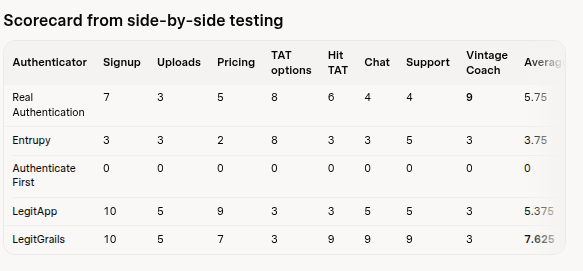
Authenticate First is zeros because signup never completed. Constant errors. No working support and no phone to fix it. That is a dead door, not a vintage grade.
The average and the vintage column tell different stories. That is the point of the table.
Pre-1990 Coach: you need Real Authentication
Real Authentication is the only paid service in this test that can authenticate vintage Coach. They scored a 9. Everyone else scored a 3 or a 0.
That is not a preference. On a Cashin bag, a pre-creed cartouche piece, an NYC creed, a glued serial, or an 1980s seven-digit unique serial, the other shops in this comparison are the wrong tool. They are also the wrong tool on a Korea-stamped “vintage leather” bag that needs a human who already knows that origin is a kill shot.
Real Authentication was accurate. Desktop and phone both work. You can get an age estimate and a certificate you can attach to a listing or a SNAD claim. You also pay for it. Support is thin—no chat, no phones—and uploads are not elegant. Pay it anyway. You are buying the only vintage read on the sheet.
LegitApp cannot authenticate vintage Coach and was accurate 38 percent of the time. LegitGrails cannot authenticate vintage Coach. Entrupy can be accurate in its lane, but that lane is phone, TikTok, and a monthly subscription with no pay-as-you-go. Device-plus-AI was built for later, more standardized production. It does not replace period stamp fonts, glove-tan pore structure, catalog geometry, or a Korea creed.
Post-1990 Coach: now you have a choice
This is the lane the apps were built for. The style number exists. Speed and a clean certificate start to matter. So do the high-volume fakes: Signature C, Soho, Demi numbers on the wrong body, viral Tabby and Hamptons copies.
LegitGrails posted the highest overall average at 7.625. Signup is easy, pricing is workable, the service menu is useful, you can message the authenticator, and they hit turnaround. Support lives on WhatsApp and can be a fight. They still cannot authenticate vintage Coach. Use them for 1990s-and-later bags when you want the file closed.
LegitApp is the cheap on-ramp. Signup scored a 10 and pricing scored a 9. Vintage is a no. Accuracy in this test was 38 percent, and the one-hour option appears and vanishes. Fine as a first look at a common 2000s style when being wrong is inexpensive. Not the last word on a listing you have to stand behind.
Entrupy belongs to people already paying the subscription and shooting from a phone. No one-off checks. Weak vintage score. A volume tool for recent pre-owned, not 1970s glove tan.
Real Authentication still works after 1990. You do not need them the way you need them on pre-1990 bags. A cheaper app can often finish a style-numbered creed. Keep Real Authentication on later pieces if the serial is odd, the collection is mixed, or you already use them on the vintage inventory and want one certificate trail, not because they are the only shop that can read a post-1994 bag.
The rule under the photos
A certificate is only as good as the eyes that issued it.
Pre-1990: no style number, Cashin label, NYC creed, glued serial, or seven-digit unique serial: do the construction work, get a specialist to name the era, then use Real Authentication. In this comparison, they are the only paid service that does vintage Coach.
Post-1990: style number on the creed: LegitGrails for the cleanest consumer result in this test. LegitApp only with the 38 percent accuracy limit in plain sight. Entrupy if you are already subscribed. Real Authentication if the bag is odd or you want one vendor for old and new.
Any decade: Made in Korea on a handbag, wallet, or briefcase is a fake. A short serial with no “No.” is a fake pattern. Signature C with a U.S. origin story is a fake. A real number on the wrong silhouette is a fake.
Convenience measures the app. Vintage Coach measures whether the app can read a bag built before Coach put the model number in the stamp. Those are not the same skill. Date the bag first. Everything else is downstream of that.
Sign in to leave a comment