
Coach Timeline: Tapestry, Stuart Vevers and Rogue
September 27, 2026 | By Vintage Icon Vault
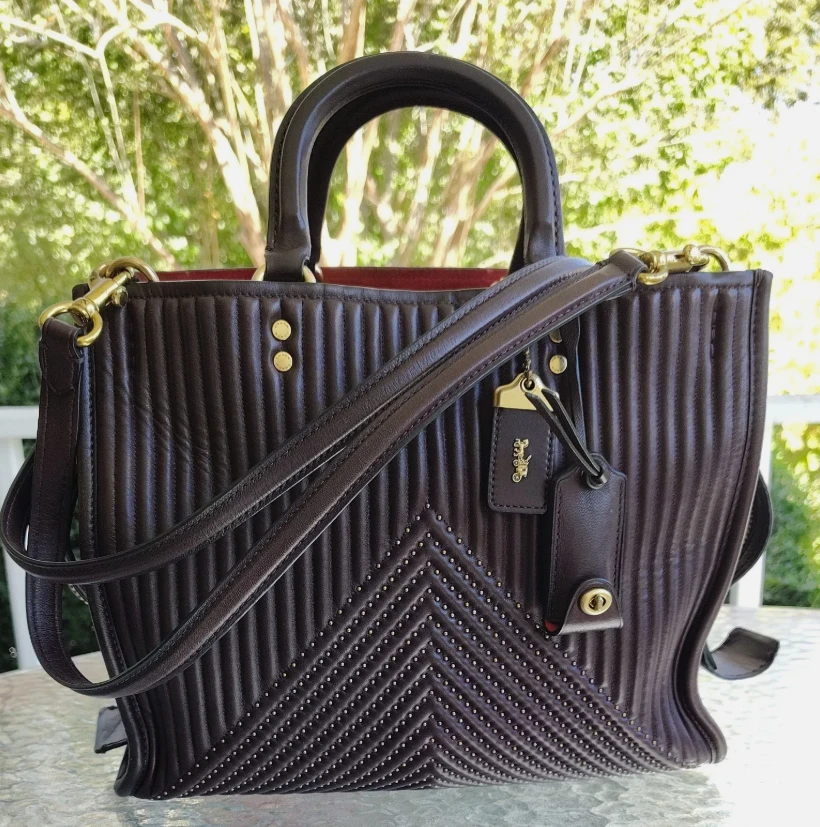
We keep saying we are a vintage house, and we are. The bags that built this shop are the ones that left a downtown New York floor when Coach still talked like a factory. We have been a bit obsessed with Rogue this year, and the ones we keep reaching for are the earliest 1941 pieces, the bags cut when Stuart Vevers was still trying to invent an icon instead of manage one. These are tomorrows vintage "Icon" pieces that we cannot get enough of today.
On October 31, 2017, the company that printed Coach on every hangtag stopped calling itself Coach. The ticker on the New York Stock Exchange flipped from COH to TPR. The parent took a new name, Tapestry, Inc., because it now owned three labels and did not want the holding company and the handbag to share a mailbox. Stuart Weitzman had been bought in 2015. Kate Spade had been bought that July for $2.4 billion. Victor Luis, the chief executive, said the new word spoke to craftsmanship, authenticity, and a house of brands. None of that changed the bag on the counter. The letterhead changed. People still write “Tapestry bag” in a listing as if the parent company stitched the hide. It did not. Tapestry is the parent. Coach is the product. If you cannot keep those two names apart, you cannot date what you are holding.
The story we actually care about started four years earlier, while the company was still Coach, Inc., still trading as COH, and still living in the long shadow of Reed Krakoff’s logo years. In June 2013 the board hired a Yorkshire designer named Stuart Vevers to take the bags back from the Signature C monogram.
Vevers was thirty-nine that summer. He had been born on 17 November 1973 in Doncaster, South Yorkshire, and raised in Carlisle, Cumbria, in a house where both parents left school at fifteen. Art was the subject that worked. The education that stuck was nightclubs in Manchester, Leeds, and Newcastle, the rooms where a working-class kid from the north learned that clothes could be a way out. At eighteen he went to London and the University of Westminster, nearly failed the first year by clubbing, and spent the rest of the degree working like a man who understood what it cost to be there.
What followed was other people’s leather. He got the Calvin Klein job in New York by showing up at an interviewer’s hotel unannounced with a portfolio under his arm. Then Bottega Veneta in Milan. Then Givenchy in Paris, where the Pumpkin bag came off his bench. Then Louis Vuitton under Marc Jacobs. In 2005 Mulberry made him creative director, and those were the Emmy and Bayswater years, the stretch that won him the British Fashion Council’s Accessory Designer of the Year in 2006. In 2008 he went to Loewe in Madrid and spent five years trying to pull a quiet LVMH house into the light. By the time Coach called, he already knew how to make a bag that people would wait for. He also knew what it looked like when a leather house forgot why anyone loved it in the first place.
Coach announced him on 24 June 2013. Lew Frankfort called the hire a milestone in a brand transformation already underway. Victor Luis, then president and chief commercial officer, said Vevers was grounded in accessories and could draw on the company’s history without being trapped by it. Vevers’ own sentence was shorter. He had long admired the heritage. He was ready to drive the next stage. He started in September, reported to Luis, and walked into a company that had already closed stores, already lost ground to Michael Kors, and already taught a generation that Coach meant a glazed Signature C on coated canvas. Krakoff’s sixteen-year contract was not renewed. Krakoff went to his own name. Vevers, an Englishman, was hired to remember that the company was American.
His first collection walked in February 2014 for Fall 2014, eighteen looks in a black-box room on the West Side, mostly black and brown, leather and shearling, a fireman’s coat, buffalo check, urban-hiker boots with a turnlock used as hardware instead of as a stamp. He named one of the bags the Rhyder. It had messenger weight and shearling and the old house lock doing a job again. He told the press he wanted utility and luxury in the same object, an American alternative to the European houses, and that the early samples which looked too much like the archive had felt like they were not changing enough. So he turned away from the obvious reprints and kept the spirit. That is still the cleanest description of how he works. He sits in the archive until he understands what people actually carried. Then he refuses to Xerox it.
A year later the company put a name on the experiment. Coach 1941, September 2015: higher prices, ready-to-wear as a real line instead of a sidecar, handbags that would not be dumped into every wholesale door. Luis later called it the laboratory, the place Vevers could use hide and color and print and hardware without the outlet calendar writing the brief. The first full runway show of that line happened the same month. The company’s seventy-fifth anniversary was twelve months away. They still did not have the bag that would have to carry the argument.
That bag took six months. Part of the work happened the way these things always happen, in fittings and revisions and arguments about a handle drop. Part of it happened when Vevers locked four designers in a small hotel by a stream in upstate New York and told them they were not leaving until the thing existed. It arrived for Spring 2016, was pushed hard in Pre-Fall 2016, and walked again with varsity patches on the Fall 2016 runway. They called it the Rogue.
We should say this without dressing it up. The Rogue was Vevers’ attempt to give Coach a new original icon. Not a reprint of Bonnie Cashin’s 1960s hardware. Not a Krakoff logo bag. Not an old silhouette with a new lining and a campaign behind it. He was trying to make a bag that could do what the Classic Shoulder had done in 1984 and what the Legacy satchel had done in 2006, which is stand for the company in a single shape. In 2016 he called it a classic for cool girls and a cool bag for classic customers. In 2021, when the house brought the shape back, he called it perhaps his favorite bag he had designed at Coach, the combination of heritage, offbeat attitude, and authentic American style that embodied his vision for the house. The name was not a western costume. It was a character. A Coach girl who wandered. A Coach girl who would not stay inside the frame.
That is why the first generation matters to us.
When we say first generation, we mean the Coach 1941 run from the launch years, the bags cut before the last got softer and before the 2021 revival started telling a new materials story over the original weight. Those early Rogues still feel like a decision. You set one down and you hear the hide. You open the sides and the suede is waiting, oxblood against black, red against oxblood, honey against pebble, burgundy against beechwood. Vevers put the luxury where a hand goes, not where a camera goes first. Some of the earliest examples still have a working padlock on the zip and a key in the clochette. That lock is a first generation tell. Later cousins often drop it, and once you have opened enough of them you stop needing a lecture. You can feel the difference.
The architecture is simple once you have lived with it. Glove-tanned pebble on the shell. Two short luggage handles with about three and a half inches of drop. A pair of detachable straps that clip for the shoulder or link for crossbody. A two-way zip down the center. A full-height open pocket on each flank, lined in suede. Inside the zip, a French-purse kisslock and a zip pocket. A leather clochette. The horse-and-carriage hangtag. Painted edges on many of the early 1941 pieces instead of a turned-and-stitched bind. Protective metal feet. The market calls the standard bag a Rogue 30 and a Rogue 31 in the same breath, and both names point at the same last, roughly twelve and a quarter by nine and three-quarters by five and a half inches. Mini 25 and Maxi 36 followed. A Rogue Satchel stretched the thought into a different last. If a seller cannot tell you which one is in the photograph, they have not measured the bag.
We have been buying the 31s first, because that is the shape Vevers locked the hotel room to finish. We have been buying the 25s next, because that is the one a person can live in without looking like she packed for a weekend. The rest we take when the hide is honest.
What moves on the resale market now is not a secret if you watch what actually clears instead of what people ask.
The workhorse is still the first generation Rogue 31 in glove-tanned pebble. Black with oxblood or black suede sides. Oxblood on oxblood. Chalk with dark handles and gunmetal. Honey, saddle, butterscotch, and light British tan with a dark lining. Heather grey pebble with oxblood suede flanks, the 23755 that people hunt by number. Steel blue and dark denim when the hide is still thick. Melon and the other short-run colors when nobody has wrecked the edges. Clean examples in those colorways leave. Beat examples in the same colorways sit on the table and teach you patience.
The numbers from that first cut are how we keep the hotel bag separate from the later cousin. 38124 is a common early pebble 31. 20315 and the RG 20315 family show up on early chalk and related 1941 pieces. 23755 is the grey and oxblood colorblock. 54536 and its cousins show up on oxblood and contrast-lined examples. Satchel variants wear their own numbers, 58023 and 58119 among them. Date codes still sit on a small tag in a pocket if no one has cut it out. We look for that tag the way we look for a creed in an older bag. It is not romance. It is a sorting rule.
After the plain pebble 31, the market splits the way our own buying has split. The Rogue 25 becomes the daily bag, same architecture, smaller footprint, easier on a shoulder that already carries keys and a phone. Colorblock 25s and short-run brights move when the suede is unstained. Then come the special-cut 31s and 36s that people already know they want: prairie rivets and western rivets set by hand, whipstitch handles on oxblood, the Fall 2016 varsity patches that say 41, haircalf, patchwork, snakeskin on the handles or snakeskin as the shell, fern and fringe and the other one-season experiments. Those are not starter Rogues. Those are the bags that find us because we have already decided we are in this family.
Then there are the Tea Rose Rogues, and once you have had a few of them open on the table you understand why they refuse to behave like the others.
Tea Rose was never a print slapped on the front. It was a 1941 motif Vevers put across the line, a flower that could be stitched on as leather appliqué, tooled into the hide so the bloom is carved rather than sewn, cast in metal and stood off the leather, or let go a little feral in the later Wild Tea Rose versions. The same rose landed on Dinkys and Drifters and small goods. On a Rogue it changes the bag from a trunk into a signed object. You stop talking about compartments and start talking about whether the bloom is still a bloom.
The versions that keep coming back in search are specific enough that we have started reciting the numbers out loud. Beechwood pebble with leather tea rose appliqué and a burgundy or oxblood lining is the warm one, style 59243, large enough to be a 30/31, the bag that photographs like late afternoon and lists toward a thousand when it is clean or still tagged. Chalk and grey Rogue 25s with tea rose appliqué are the wearable roses, 58840 on chalk, 86844 as Wild Tea Rose on chalk pebble. Those sell because a 25 with a flower is still a 25. Black with pink or purple roses is the evening version of the same idea, 87065 among the black and pink 25s, 21587 among the tooled black multi 25s. Tooled is not appliqué. Tooled means the rose is in the leather. That difference is worth money if the tooling is sharp, and worth nothing if a seller uses the word for a sticker.
Then the scarce cousins, the ones we do not see every week. Style 58964 is the black multi snakeskin tea rose Rogue 30 that lists in the four figures when the skin is intact. Peony pink snakeskin with tea rose and rivets is the loud one. Metal tea rose on willow or black, sometimes with a metal handle, is the one people save a search for. We treat those the way we treat a rare color in an older line. You do not talk yourself into them. You wait until the object is right.
And you read the rose before you pay for the name. Appliqué roses lift and scuff. Tooled roses flatten if the bag lived under something heavy. Metal roses bend. Snakeskin on a rose bag will tell on a thumbnail. A Tea Rose Rogue with a crushed bloom is just a Rogue that had a flower once. We have sent those back.
The Rogue was the first invented icon of the Vevers years. It was not the last bag he put into the world, and the rest of the line is how you keep from calling every later success by the same name.
The Rhyder came first, Fall 2014, the messenger that announced the lock would be used as a tool again. The Ace and the Saddle sat beside the Rogue in those 2016 showrooms, one a structured satchel, one a flap that remembered a different American object. The Mercer, also 2016, was a clean top-handle with a turnlock for the woman who still wanted a city bag that closed. The Dinky came back off the archive as a 1941 object instead of a costume. The Swinger followed the same path later, Cashin’s idea cut on Vevers’ last, which is a sentence that means something in this shop because that is the family we came from.
In 2018 he issued the Dreamer, a softer satchel with an open top, exterior pockets front and back, a C charm, sizes 21, 29, and 36. The copy said New York and the American dream. The construction said tote that could dress. Tattoo motifs from Chelsea Champlain sat on some of them. It was the second original Vevers carryall after the Rogue, looser in the hand, less of a trunk, and it never quite occupied the same place in our heads. In Fall 2019 he reached into the 1970s and pulled the Tabby. That one is not an invention in the Rogue sense. It is an archive silhouette, Cashin-era messenger logic with a T-flap and an adjustable strap, rebuilt with an oversized Signature C on the face. The Tabby is the bag the internet learned. The Pillow Tabby, padded during the pandemic because Vevers thought people would want something that felt like comfort, is the bag the internet memorized. He has said he had never seen a reaction like it. The house had trouble keeping it in stock. That is a different chapter. The Rogue was designed in a hotel to restart a brand. The Tabby was designed in an archive to give the restarted brand a face the camera could find.
Later still came the Brooklyn, a slouch hobo with almost no hardware, an original again. Kisslock frames. Nolita. Empire. Turnlock totes that point back at Cashin without wearing her initials. Collaborations that are not the subject of this page. Vevers has always run two workshops at once. One invents. One reprints. The Rogue belongs to the first. The Tabby belongs to the second. A listing that calls every Vevers bag a Rogue is a listing that has not opened the bag.
The parent company belongs in this story only because that is the week people still ask about.
Coach, Inc. spent 2015 and 2017 buying neighbors. Stuart Weitzman in May 2015, up to $574 million, shoes. Kate Spade & Co. in July 2017, $2.4 billion, a younger handbag customer Luis wanted in the building. On 11 October 2017 the company announced it would stop being Coach, Inc. On 31 October the change was legal. Tapestry, Inc. The stock symbol TPR. Carbone Smolan Agency did the naming work. Luis said they needed a platform where each brand kept its own face, so a woman buying Kate Spade would not think she was walking into a Coach store. He also said most millennials had not heard of Carole King’s "Tapersty" record of the same name, which tells you who they were talking to.
Vevers was not the author of that rename. He was four years into the Coach brand when the letterhead changed. His job did not become Tapestry creative director. It stayed Executive Creative Director, Coach. The 1941 hangtag stayed. The creed stayed. The horse and carriage stayed. What changed for a buyer is only this. After Halloween 2017, a press release about the corporation and a hangtag about the bag are no longer the same document. Read the hangtag.
The 1941 line is still the paper trail we trust. A first generation Rogue will usually carry the Coach 1941 designation, a creed patch with a style number, and construction heavier than the outlet bags that kept rolling in parallel. The suede side pockets do not lie. The lock and key, when they are present, do not lie. The rose, when it is present, has to be named for what it is: appliqué, tooled, metal, or wild. That is the same referee the 1984 catalogue was, and the same referee the 2006 Legacy book was. The object tells you which company made it. The parent company’s stationery does not.
If you have been around this shop, you already know how we hold the three seasons.
1984 is the last year the factory could describe itself as a downtown New York floor cutting one hide. 2006 is the year they sold the founding date back as a coin and a striped lining. 2013 to 2017 is the year an English accessories designer was hired to invent a new original because the logo had eaten the leather, and the year the corporation that paid him decided it was now a tapestry of brands instead of a single name.
The Rogue is the bag from that interval that still behaves like a Coach bag in the old sense. Hide you can hear. Suede you can feel. Hardware that does a job. A name that describes a person instead of a pattern. It did revive the brand, in the only way a bag can. It gave people something to carry that was not a reprint and not a billboard. The Tabby later gave them something to photograph. Both are Vevers. Only one of them was built in a hotel to restart the house.
We are not calling it vintage. We are offering the first generation anyway. Pebble 31s in black, oxblood, chalk, honey, and grey. The 25s a person can live in. The Tea Rose bags where the bloom is still a bloom. If a listing says Vevers and does not show the side pockets, we open it ourselves. If it says Tapestry and means the hangtag, we keep walking. If it calls a Tabby a Rogue, or a later revival a first generation, or an appliqué rose a tooled rose, we already know how the story ends.
Coach kept its name on the leather. The company that owns Coach did not. The Rogue is how we can still tell the difference, and this year that has been enough to bring the bags into the warehouse and leave them there.
Shop the Coach 1941 Rogue Collection here:
https://vintageiconvault.com/catalog?collection=coach-legacy&line=1941-rogue
Sign in to leave a comment