
How to Date a Vintage Coach Bag and Determine the Style Name
September 19, 2026 | By Vintage Icon Vault
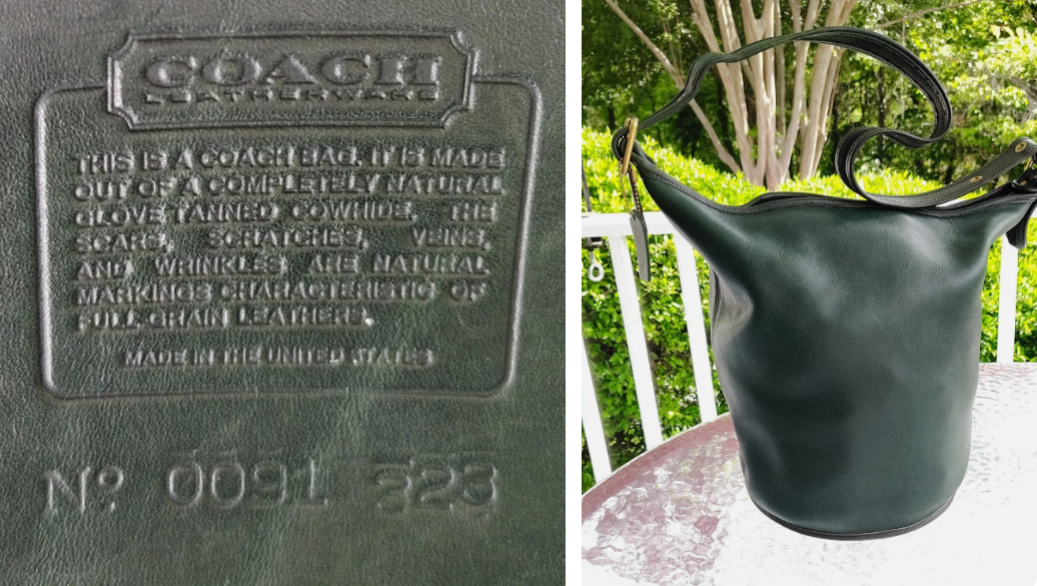
Most dating arguments start the same way: somebody treats the creed stamp like a decoder ring. On a pre-1994 bag, that is the wrong tool.
Coach changed systems. Before 1994 the number under the creed is a unique bag ID. It does not encode year, factory, or style. After 1994 the stamp does carry production data. Mix those two eras and you will date the bag wrong and name the style wrong as well.
The Hunter Green Feed Sac in the photos is the example. Same rules apply to other vintage Coach bags.
First split: 1994
Before 1994: all-numeric stamp. One number per bag. Never reused. No date inside it. You date the bag from creed wording, the Made in line, stamp format, hardware, leather, and catalog colors.
1994 and after: letter, year, plant, then a style number. That is the first era where the stamp itself can tell you month and year.
If someone tells you a four-then-three numeric creed “decodes” to a year or a Coach style, they do not know the system.
How to date the Hunter Green Feed Sac
This bag is the classic slouchy Coach Feed Sac / Duffle Sac: bucket body, long adjustable strap, brass hardware, hang tag. People later list the large version as style 9085. That style number is useful after 1994. It is not how you date this one.
Stack the marks on this bag:
- The creed talks about glove-tanned cowhide and the scars, scratches, veins, and wrinkles of full-grain leather. That is older U.S. production language.
- The last line says Made in the United States, not Made in New York City. Coach changed that wording when production expanded beyond the original NYC plant, starting around 1988.
- The stamp under the creed is all numbers in the four-then-three format. That format ran roughly 1989 through 1993.
- Hunter Green / Forest Green was a late-80s into early-90s color, in catalogs from the 1989 fall preview and into the early 1990s.
Put those together and this Feed Sac dates to 1989–1993, most likely 1990–1992.
You cannot get a single calendar year or manufacturing plant location out of the creed number. On this bag the last three digits are just this bag’s individual ID. No two authentic pre-1994 bags share it.
Pre-1994 dating method
Use this on any vintage Coach from that era, including this Feed Sac.
Read the creed, not just the digits
Early vintage creeds mention glove-tanned cowhide and natural full-grain markings. Then read the last line:
- Made in New York City — earlier production, original plant.
- Made in the United States — after Coach added U.S. plants outside NYC, about 1988 onward.
That one line moves a bag across the late-80s line. This Feed Sac is on the United States side.
Use the number format, not the number itself
The digits do not mean a date. The shape of the stamp does.
- No serial / tiny Coach stamp only: pre-creed, late 1960s into the early 1970s.
- Glued-in number: late 1970s into the very early 1980s.
- Three-then-four numeric stamp, often NYC: early to late 1980s.
- Four-then-three numeric stamp, usually United States: about 1989 through 1993.
This Feed Sac is the last group.
Confirm with color
Coach did not run every color every year. Hunter Green / Forest Green on a Feed Sac with a four-then-three United States creed belongs in that 1989–1993 window. Color alone is not enough. Color plus creed format plus Made in line is.
After 1994
Now the stamp is a production code: month letter, year digit or digits, plant code, then style number.
Month letters run A through M and skip I. A is January. M is December. J is September.
Single year digits cover 1994 through 2003. Two-digit years start in 2004.
After 1994 the last block is the style number. On a later Feed Sac / Duffle Sac that block is often 9085. If those digits do not match the bag in your hand, stop.
This Hunter Green example is not in that system. Do not force a 9085 reading onto a pre-1994 numeric creed.
What does not date a Coach bag
- Treating a pre-1994 numeric creed like a date code.
- Calling every Feed Sac “an 80s bag” or “a 90s bag” because the shape is familiar.
- Using only the hang tag. Tags get moved.
- Using only Made in USA as if that were a year.
- Claiming the last three digits are the year. On this bag they are not.
A readable post-1994 code can still be copied onto a fake. Leather, stitch quality, hardware, creed spelling, and whether the style matches the silhouette still matter.
Fast field method
- Is the stamp all numbers, or letters plus numbers?
- All numbers means pre-1994. Date from creed text, city or country line, format, color, and hardware.
- Letters plus numbers means 1994 or later. Read month, year, and plant, then confirm the style block matches the bag.
- Check the color against known catalog years (check out Vintage Icon Vaults "Resource" Tab.
- If two clues fight, believe the physical bag over the listing.
This Hunter Green Feed Sac is the clean version of that method: United States creed, four-then-three numeric stamp, period-correct green, classic Feed Sac silhouette. That is a late-80s to early-90s bag, most likely 1990–1992. The number under the creed identifies this bag. It does not date it.
Sign in to leave a comment