
The Time Capsule: Coach 1984 Spring Catalog - Before Sara Lee
September 19, 2026 | By Vintage Icon Vault
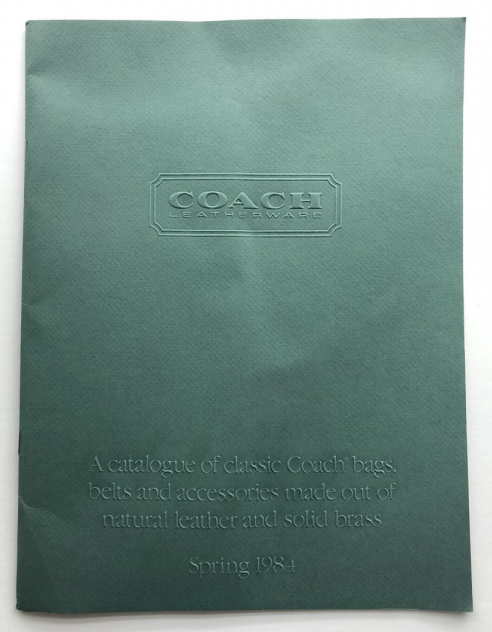
The cover is green. Not the loud green of a later logo campaign. A closed, almost military green, the color of a ledger more than a fashion book. The name is not printed in ink. It is pressed into the stock so you feel COACH LEATHERWARE before you read it. Under that, one sentence and a date:
A catalogue of classic Coach bags, belts and accessories made out of natural leather and solid brass. Spring 1984.
https://vintageiconvault.com/resources/1984-spring
That is the whole pitch. No lifestyle spread. No celebrity. No claim that a bag will change your life. Leather and brass, made by the people who made it last year and the year before that.
If you want the Coach story in a single object, this is a good one to hold. Not because 1984 invented the company. Because 1984 is the last season the company could still describe itself without flinching.
Coach begins, as they tell it in this book, in 1941. A small family-owned shop turning out leather bags, belts, and billfolds. By the spring of 1984 they have been at it forty years. The workforce is in downtown New York, drawn from the city’s separate ethnic neighborhoods, and the catalog makes a point of saying the product is possible because of that shop floor, not despite it. Everything in the book, they write, was cut and sewn in that one factory. Nothing contracted out. Nothing bought in. Nothing imported to fill a hole in the line.
That is not a branding flourish. It is a production fact, and it is the fact that later catalogues will have to dance around.
They already cannot make enough. Demand has outrun the floor. So they stay choosy about who sells the bags, only the better department and specialty stores, and they open their own doors where they can control the counter: 73 Rue Jacob in Paris, 754 Madison Avenue, 73 Newbury Street in Boston, 1244 Wisconsin Avenue in Georgetown, 164 Grant Avenue in San Francisco, 417 University Street in Seattle. You are invited, in the language of 1984, to come in, examine, try on, and choose from everything they make in every color and size they make it in. No appointment. No velvet rope. Just the inventory.
They also tell you they do not sell the mailing list. A small thing. It tells you who they think they are talking to.
Turn the page and the leather gets a name.
Except for a short run of water-buffalo wallets in the back of the book, every bag and belt in Spring 1984 is the same hide: full-grain, uncorrected, glove-tanned cowhide. They do not analogize it to butter or petals. They analogize it to a baseball glove. They worked with a glove tanner. They mixed extracts and emollients until the hide went soft in the hand without having its scars sanded off or painted over. Clear aniline dyes only. The veins stay. The scratches stay. The wrinkles stay. Painted leather, they write, peels and cracks. This leather darkens and takes a patina.
That sentence is the entire later market for vintage Coach, written before the market existed. The bag is not finished when it leaves downtown New York. It is finished on the shoulder.
The small pieces, coin purses, keycases, eyeglass sleeves, the two makeup kits are the same hide sent through a splitting machine until they handle like calf. Two kits get a treated cotton ticking because makeup spills.
Everything else in that tray is leather-lined, brass-zipped, brass-snapped. They called them Bag Fittings, which is a factory word, not a boutique word. You buy the bag. Then you buy the things that live in the bag, cut from the same animal.
Water buffalo is a different animal and they are honest about it. Vegetable tannage in pits, crust leather shipped stiff and pale, then drum-dyed in-house until the grain looks like wood and the hide has that dry veg-tan squeak.
Wallets, a French purse, a passport case, checkbook covers. Eight colors. If a seller forty years later calls a billfold glove tan because the hang tag says Coach, the Spring 1984 book already told you otherwise.
The design speech is short, which is how you know it is a design speech and not an ad.
No gadgets. No gimmicks. No lining to tear. No cardboard to break. Generous cuts, double-stitched where a seam has to work. An outside seam and a continuous leather binding around the edge so the bag does not come apart the first year someone actually uses it.
Then the origin they chose to print: every bag in the catalogue is a variation of one construction, and the first bag they ever made that way is the Classic Shoulder Bag, No. 9170. Soft, unlined, casual. Ten inches by nine by four. A zipper under the flap and a second compartment behind it. Solid brass adjusting buckles. Ninety-six dollars.
Fashion, they write, has come and gone since they introduced it. The bag has not.
That is the Coach story in one silhouette. Not the later monogram. Not the runway collaboration. A pouch with an outside seam and a binding, made until the hide ran out.
From that pouch the line radiates like a family. The Small Shoulder Bag is the same thought, scaled down, seventy-six dollars. The Stewardess is the same thought given brass feet and an industrial turnlock so a working bag survives an airplane floor, eleven inches square, one hundred twenty-six dollars. The Crescent is the same thought curved into the ribcage, a hundred dollars, a body-hugging strap an inch and a quarter wide. The Courier tucks its flap in so the bag shrinks around what you put in it. The Duffle Sac is the same leather pulled into a feed bag with a circular bottom, slung, one hundred sixteen dollars. The Musette is the same leather gone large enough for a model or a photographer to disappear a day’s kit into, sixteen by eleven by five, one hundred ninety dollars, the most expensive bag in the book.
The little ones are not afterthoughts. The Dinky, No. 9375, is nine by five by two, a one-piece tubular handle, a solid brass turnlock, an inside zip, fifty-four dollars. The copy says it doubles as an evening bag, which is a polite way of saying a woman can carry it from daylight into a restaurant without changing armor. The Compact Pouch is the Dinky squared off. The Small Zippered Pouch is the Dinky with the flap removed and a zipper put in its place. Same footprint, different mouth.
The Basic Bag is the one they admit started a look: a soft clutch that swings off the hip on detachable straps, brass zipper, wrist-strap pull, eighty dollars. The Convertible Clutch is that idea with a flap. The Slim Satchels are the idea stood up and given a handle. The totes: Dinky, Small, Standard, then the Marketing Tote and the Skinny Tote, are the idea opened at the top and asked to carry groceries or a legal pad. The Brief Bag at one hundred seventy-two dollars is the idea put in a man’s hand on a New York sidewalk, which is how they photographed it.
None of this is a collection in the modern sense. It is one construction, resized, until the factory has a bag for the job.
They were already selling the spare parts. A bound-edge strap, thirty-six inches by an inch and a quarter, four brass eyelets, seventeen dollars, will fit the Stewardess, the Crescent, the Courier, the Duffle. A one-inch strap at fifteen dollars fits the Classic and the Small Shoulder. Trigger-snap straps at twenty dollars come in thirty-six and forty-four. A replaced strap on a forty-year-old bag is not a scandal. The factory put the spare in the book. A wrong strap is a different sentence.
The colors are ten, and they hang from beaded brass chains on the third page so you can see the tags the way a counter would see them: Tabac. Red. Black. Saddle. Mocha. Navy. British Tan. Sage. Burgundy. Putty.
Print, they warn you, cannot reproduce glove-tanned cowhide. Send for the swatches. That warning is still good. A phone photograph of British Tan and a phone photograph of Mocha will lie to you in the same direction. The hide moves in the light. The dye sits in the grain, not on top of it.
Not every bag was cut in all ten. The book is specific, last by last. Most of the shoulder line runs Black, British Tan, Burgundy, Mocha, Navy, Putty, Red, Tabac. Sage lives on the color card and on the fittings. Carriage belts come in Black and Mocha only. If a listing needs a rare color to make the price, open this catalogue before you open your wallet. The factory already told you what it dyed.
They had a counterfeit problem in 1984. They did not write a white paper about it. They wrote one rule:
It is not a Coach Tag unless it has our name on it, and it is not a Coach Bag unless it has our tag on it. Imitation lozenges were already hanging on imitation bags. The tag is the handshake. The hide, the binding, the brass, and the construction are the person.
Belts come from the same floor, the same machines, the same operators. The buckles are not plated. They are sand-cast solid brass from a foundry that had been pouring horse hardware for a hundred years. Tab belts, harness belts, a bridle belt with a square polished buckle, carriage belts folded by hand along both edges and around the tip. Then a tray of wool and linen belts with leather tabs, Scarlet, Navy, Sky Blue, Natural, and the stripes, because not every waist wanted hide in July.
For forty years, they write, they have tried to keep the standard of the craft. Demand has pressed them. They have chosen, in the face of that pressure, to remain a small, privately held company, committed to the work and the service. Whether you buy from a department store or from the factory itself, they will go to great lengths to stand behind the thing.
Read that paragraph slowly.
Sara Lee announced the acquisition of Coach in 1985. Spring 1984 is the last full season in which “we chose to stay small and privately held” is a fact and not a memory. The bags do not go to pieces the morning the papers are signed. Leather has a lag. Operators have a lag. What changes first is the incentive. A factory that waits for a hide to look like itself is not the same machine as a company that needs more doors, more SKUs, more green in the window.
They were not just a food company at the time. Sara Lee (renamed from Consolidated Foods in 1985) was a conglomerate that also owned Hanes, Playtex, Champion, L’eggs, Kiwi shoe polish, and other apparel and household brands. Coach went under their Hanes Group.
Miles and Lillian Cahn sold because they wanted to focus on their Coach Farm goat-cheese operation in upstate New York. None of their kids wanted the leather business. They split $1 million of the proceeds with longtime factory workers. Lew Frankfort took over as president.
Sara Lee expanded Coach: more stores, department-store boutiques (Macy’s etc.), new product lines. By the late 1980s they were pushing volume. That period is why vintage collectors distinguish “pre-Sara Lee / early Cahn” bags (the classic glove-tanned, NYC-made pieces) from the later expanded catalog.
Sara Lee kept Coach until they decided to focus on core packaged goods. They sold 19.5% in the October 2000 IPO, then finished the spin-off in April 2001 by exchanging the rest to Sara Lee shareholders. They booked about $1.1 billion in net value from the whole exit. Coach became independent (later Tapestry)
You can watch the change in the books that follow this one. Twill arrives in 1985, khaki cotton with Tabac trim, a stain-resistant pitch. The voice gets more retail. The line gets louder. The construction that began as an unlined pouch with a binding has to share the floor with ideas that photograph better than they age.
Spring 1984 is still quiet. Green cover. One leather. One factory. One construction. Ten colors. A hang tag on a brass chain. Prices good through June 30.
That is why this season still matters when you pick a bag up instead of decorating a shelf. The Dinky in this book is fifty-four dollars and nine inches wide. The Classic Shoulder is ninety-six and the first of its kind. The Musette is the big one. The Stewardess has feet. The strap with four eyelets is a factory part. The wallet may be buffalo. The bag should be glove tan, unlined, bound at the edge, sewn in New York, and darkening the way they said it would.
The Coach story has louder chapters. Bonnie Cashin’s hardware and whipstitch belong to the years before this book. The C logo, the coated canvas, the outlet calendar, the celebrity campaign belong to the years after it.
Spring 1984 sits in the middle like a held breath: the family factory at full voice, just before the voice gets sold.
Open the green cover when you need to hear it. The stock still takes a fingerprint. The name is still pressed in, not printed on. Leather and brass. That was the whole pitch. It was enough.
Sign in to leave a comment