
The Time Capsule: Coach 2006 Catalog Legacy 65th Anniversary
September 20, 2026 | By Vintage Icon Vault
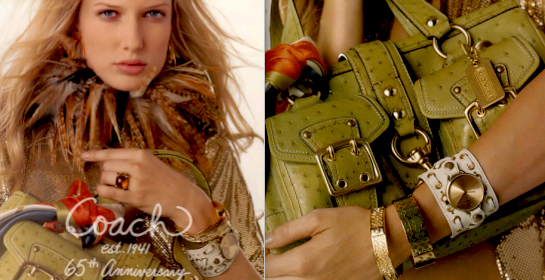
Blonde hair, a collar of feathers, gold mesh, a ring the size of a knuckle. Lime bags stacked in the lap, ostrich grain, oversized buckles, a scarf knotted through the handle like a flag. Across the leather, in the handwriting they
were teaching the world to recognize:
Coach. Est. 1941. 65th Anniversary.
https://vintageiconvault.com/resources/2006-65th-anniversary-legacy
By 2006 Coach was no longer a family factory on a downtown New York floor telling you the hide was the same hide used for baseball gloves. Sara Lee had bought the company in 1985. Reed Krakoff had been reshaping the look since the late nineties. The C logo had already done its work. What the sixty-fifth year required was a different trick: sell the founding date back to people who had never seen the founding product.
They called that trick Legacy.
Turn one page and the word itself is the design. LEGACY, gold letters dropped across a field of horizontal stripes, orange, grass, white, magenta, navy, brown, ice blue. Those stripes are not decoration. They are the interior of the bags. If you have handled a real 2006–2008 Legacy piece, you already know the lining before you unzip it. Multicolor satin stripes, the same rhythm as the divider page. That lining is how the market tells these bags apart from every other Coach that later borrowed the word “legacy” and meant something else.
Coach has used the word carelessly for years. This catalogue is specific. This is the sixty-fifth anniversary line. Select stores. A short window. Leather that still had weight, brass that still had mass, and a hang tag that stopped being a plain lozenge and picked up a struck medallion: Coach, established 1941, in a circle, like a coin you could bite. The Coach tag rule still applied. It is not a Coach bag without the tag. In 2006 they added a second sentence the factory never needed: it is not this Coach bag unless the coin is on the chain and the rainbow is in the lining.
The bag that carries the argument is the Mandy Legacy Leather Satchel, No. 10330. Look at what they put on it. Two top handles. A strap across the face that ends in an oversized brass snap hook, the kind of hardware a harness maker would recognize and a department-store buyer would photograph. Two buckled pockets on the front, each buckle punched with a double row of grommets. Turn-lock pockets on the ends. Contrast stitching that sits on the hide like handwriting. A leather hang tag and the anniversary coin hanging off a ball chain. Zip the top and the stripes are waiting.
Collectors call versions of this Legacy 65th Anniversary family Mandy, Leigh, Ali, Gigi, depending on the strap and the year and which creed number is inked inside. The catalog in your hand names this one what the factory named it that season: Legacy Leather Satchel. The nickname market came later, when people had to hunt the bags without the book.
The next spread is where Coach stops selling a bag and starts selling a uniform. Zoe clutches laid out like a jeweler’s tray, stripe against leather, green against ice, gold metallic, punch against magenta, black with a stripe coin purse clipped to the ring. Amazon. Ebony. Orange. The beret that matches the muffler. The muffler that matches the lining. The lining that matches the silk square you thread through the clasp so the bag and the neck finish each other’s sentence. Enamel bangles stacked in the same stripes. A medallion bracelet. Signature cuffs in gold and silver pairings. Nothing on the page is meant to stand alone. You were supposed to leave the counter wearing the interior.
This is not the pre 1984 "Sara Lee" voice. The 1984 voice told you there was no lining to tear and no cardboard to break. This voice tells you the lining is the point. The 1984 voice sold a spare strap for seventeen dollars because the bag was expected to outlive the first one. This voice sells a nine-hundred-ninety-eight-dollar watch and a coyote hat because the bag is expected to go out at night.
Here is why the Legacy pieces from this book are the ones people are fighting over now:
First, the supply was short on purpose. The copy on these pages keeps repeating the same four words: all items in select stores. Not every door. Not the outlet calendar. A birthday line, then the next season. The lining continues into 2007 and 2008 on related shapes, which is why a creed date matters and a stripe lining alone is not a sixty-fifth-anniversary certificate. But the satchel on this spread, the Zoe turnlocks, the coin on the chain. was never a volume product. You cannot restock a birthday.
Second, the construction still had a body. This is not the coated-canvas flood that trained a generation to think Coach meant a glazed C and a light bag. The 10330 is hide you can hear when you set it down. The hardware is brass you can feel in the palm. Contrast stitching, turned edges, a hook that looks like it came off a stable door. People who burned out on later Coach and then went looking for “real leather Coach” land here before they land in 1984, because this is the last season the company made the old weight and still knew how to photograph it.
Third, the tell is visible in a listing thumbnail. Stripe lining. Anniversary medallion. Double-grommet buckles. That hook. Whiskey, black, and the white that scuffs and therefore got put away. You do not need a monograph to spot the family. You need a zipper and a flashlight. In a market drowning in “vintage Coach” that is not vintage and “legacy” that is not this Legacy, a tell you can see from three feet away is worth money.
Fourth, the culture caught up to the year. Mid-2000s Coach sat in the unfashionable gap for a decade, too new to be heirloom, too old to be current. Then the same eye that pulled Y2K heels and logomania back onto the feed found these bags. Heavy brass. Candy lining. A satchel that looks like a saddle if you squint. The 1984 Classic Shoulder is a quiet object. The 10330 is not quiet. It photographs. It trends. Demand that photographs will outrun demand that only feels right in the hand, at least while the camera is on.
Fifth, the clean ones are already gone. White leather from 2006 does not stay white. Brass from 2006 does not stay bright unless someone cared. The stripe lining pills and stains. A satchel that left the store at six hundred ninety-eight dollars and lived in a closet is a different object from one that lived in a car. That is why the same style number now lists anywhere from the mid hundreds to a thousand and change, and why whiskey and black in tight condition pull away from the pack. You are not paying for a logo. You are paying for twenty years of someone not ruining the birthday present.
Watch the comps with both eyes. Asking prices on the 65th Anniversary Legacy Family run from the high four hundreds into four figures. Sold whiskey and black satchels in the last year have cleared the mid-hundreds to the mid-seven-hundreds when the leather and the coin are intact. Some sellers test the ceiling north of a thousand. That spread is the demand. It is not a single number. It is a fight over the ones that still look like the page.
Hold the two books next to each other and the Coach story tightens.
1941 is the date both of them sell. 1984 sells it as a factory that still makes the thing. 2006 sells it as a memory of a factory, cut into stripes and struck into a coin and hung on a bag that knows how to walk into a photograph. One is the last quiet season. The other is the year they put the memory on the cover and charged six hundred ninety-eight dollars for a satchel that could carry it.
The people buying Legacy now are not confused about which chapter they want. They want the chapter where Coach still used enough hide and enough brass to make the anniversary look expensive, and then stopped making that many of them. They want the lining you cannot fake in a thumbnail. They want the hook. They want whiskey that went honey and black that went soft and white that somehow survived.
Open this catalogue when a listing says Legacy and does not show the lining. Open it when the hardware looks thin. Open it when the price assumes you will not know the difference between a birthday bag and a later bag that borrowed the name. The page is still the referee.
Coach. Est. 1941. The date was always the product. In 2006 they finally printed it large enough to see from across the room. That is why these pieces moved then. That is why they move now.
Sign in to leave a comment