
The Timeline: Coach Branding, Labels and Creeds From Bonnie Cashin Era 1960's To Present
October 5, 2026 | By Vintage Icon Vault
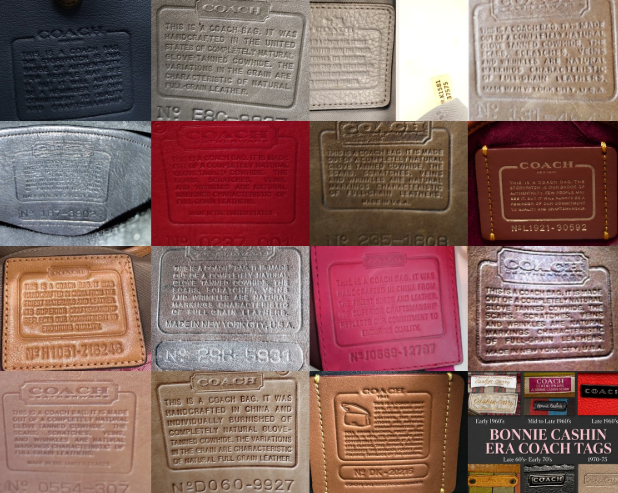
Coach’s marks never line up in a single clean sequence. From Bonnie Cashin’s first designs in 1962 through the present, labels, metal plates, cartouches, and creeds overlap. Collectors who treat any one stamp as a universal decoder misread the object.
1962 to 1975: COACH's BONNIE CASHIN ERA
1962–1973: Fabric and Metal Labels
The first marks were sewn fabric. They read “A Bonnie Cashin Design for Coach,” then “Cashin-Carry for Coach,” then cloth Coach Leatherware tags that still carried her name. Metal plates enter mid-decade: a small framed “COACH” riveted into the hide. These plates are hardware, not a creed and not a story. A small leather tag follows near the end of the sixties. Cloth and metal run together through the period. Neither replaces the other on a fixed date.
1973 to 1975: The Cartouche
Around 1973 the mark changes. It stops being sewn or riveted and becomes an embossed rounded rectangle pressed directly into the leather. Collectors call this the cartouche. On handbags the form is brief, roughly 1973–1975. On small leather goods it lasts longer. There is no paragraph and no serial number. If the only interior mark is that frame, the bag was made before the creed.
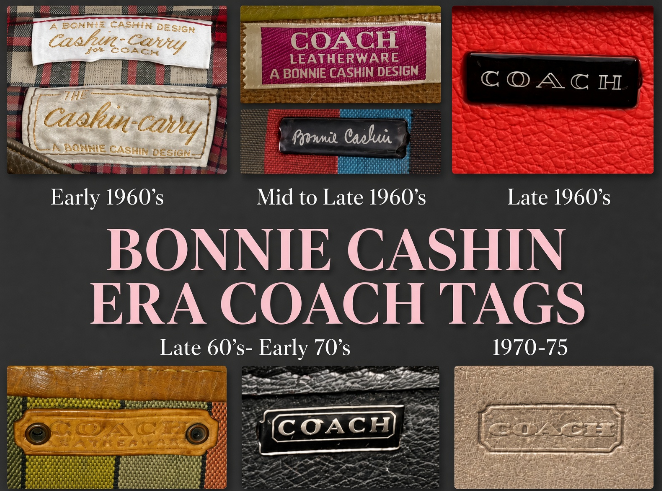
* Pictured above: Coach Labels From Bonnie Cashin Era at Coach
1975 to 1983: THE ICONIC COACH CREED ARRIVES
1975- 1979: Around 1975 the interior gains a paragraph. Collectors call it the Coach Creed, or the story patch: an embossed rectangle with the Coach logo at the top, a short claim about the hide and the work, and eventually a number beneath it.
The earliest creeds often carry no number at all. That absence is characteristic of the mid-seventies, not a missing stamp.
1979 to 1983: By 1979 serial registration numbers appear. They start as glue-in strips, then shift to numbers stamped directly into the bag. These run from the late seventies into the very early eighties, while the creed itself is also stamped into the leather. The number under the creed in this period is a unique registration number. It identifies the individual bag. It does not encode the year, the plant, or the style.
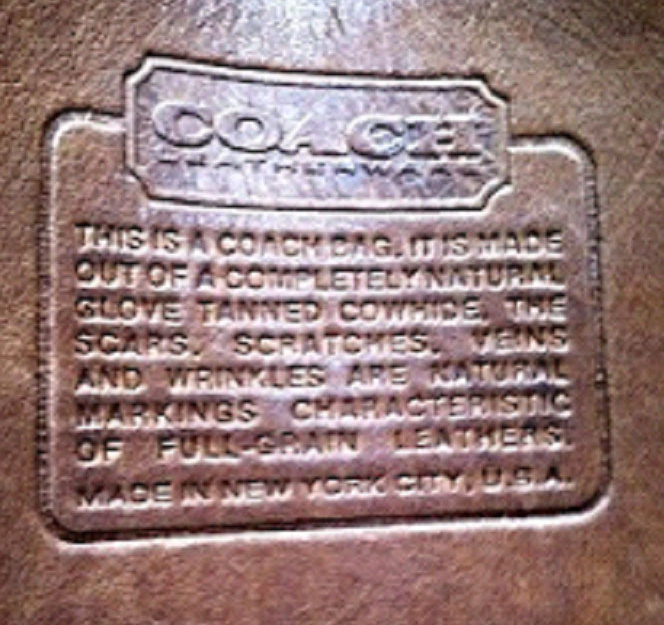
* Pictured Above Coach Creed Stamp No Serial Numbers Known as "pre Creed"
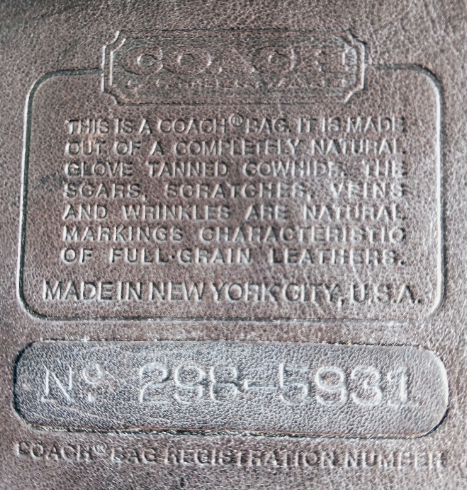 * Pictured Above: Coach "Glue In" Bag Where the Serial is a Leather Patch Glued-Into the Bag.
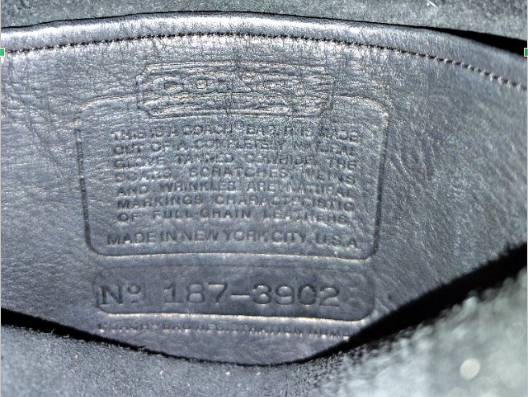
* Pictured Above: Coach "Stamp In" Bag Where the Serial is Framed Inside A Rectangle Stamped Into the Bag.
1983 to 1994: STAMPED IN REGISTRATION NUMBERS: MADE NEW YORK CITY, U.S.A. FIRST, THEN MADE IN THE UNITED STATES
Before 1994 those numbers are registration numbers, unique to each bag. They do not encode the month, the year, the style, or the plant. You cannot read 482-1196 as a style, a date, or a factory location. The bag is dated from the wording above the number, the hide, the hardware, and the catalogs. The formats shift slightly across those years, and the shift itself helps place the date of the piece.
Creed wording, serial formats, and stamp styles overlap, and factory errors sit inside genuine production. A piece that misses one expected mark is not, by that fact alone, a fake. Dating still rests on the whole object: the wording above the number, the hide, the hardware, and the catalogs. A bag that fails the chart and also fails the leather and the hardware is a different question. The two number shapes do not hand off on a single year. Glue-in and stamp-in registration numbers run beside each other, so forcing either format onto one clean date range invents a line the bags never drew.
- 1983 to 1986 (approx): A stamped number in the 000-0000 shape, with “Made in New York City, U.S.A.” or “Made in NYC” under it, is the early-to-mid eighties Coach factory claim in New York City.
- 1986 to 1988 (approx): The line changes to “Made in USA” or “Made in the United States,” still often in the 000-0000 shape, with known examples into the early nineties.
- Late 1988s through 1994 (approx): The digits flip to 0000-000 and the “Made in” line stays American.
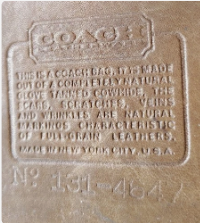
* Pictured Above: Coach "Made in New York City, U.S.A" Registration Creed (Made Between 1983 to 1986 approx)
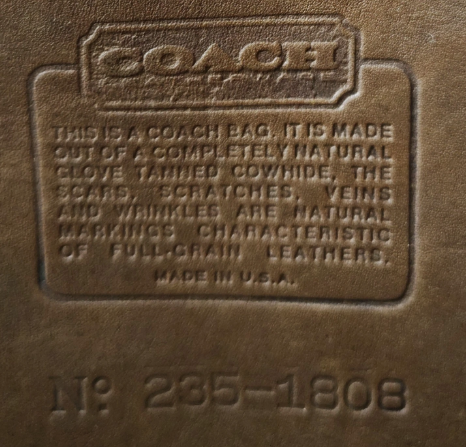
* Pictured Above: Coach "Made in U.S.A." Registration and Creed Stamp (Made Between 1986 to 1988 approx)
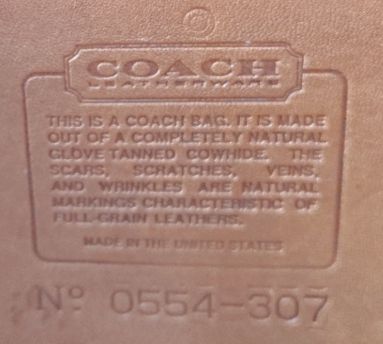
* Pictured Above: Coach "Made In The United States" Registration and Creed Stamp (Made Between 1988 to 1994 Approx)
1994 to 2006: THE MONTH, YEAR, PLANT & STYLE NUMBER ON THE CREED
1994 is the year the creed serial stops being a unique registration number and starts encoding four fields: month, year, plant, and style. Before 1994 the stamp is numeric only (formats such as 000-0000 or 0000-000). It identifies the bag. It does not date it, and it does not carry a catalog style number.
Read a 1994–2006 creed left to right: month letter, year digit or digits, plant code, dash, style number. Example: K8P-9870 is October, year digit 8, plant P, style 9870.
Month. The leading letter is the production month. A is January, B February, C March, D April, E May, F June, G July, H August, J September, K October, L November, M December. I is omitted so it cannot be read as a 1. A leading I is not the standard format. N is also outside the sequence. Both show up as stamping errors on real bags and as a common mark on counterfeits, so either one has to be authenticated from the rest of the bag, not from the letter alone. An F in this position is June. It is not a factory mark.
Year. One digit from 1994 through 2003: 4 = 1994, 5 = 1995, 6 = 1996, 7 = 1997, 8 = 1998, 9 = 1999, 0 = 2000, 1 = 2001, 2 = 2002, 3 = 2003. From 2004 the year goes to two digits: 04, 05, 06. Two traps sit in the single-digit field. A lone 0 can be 2000, and the same single-digit form was still used later, so it is not a clean year. A lone 4 is not automatically 1994. Costa Rica bags from 2004 are documented with a single 4 because that plant was closing and was not issued the new two-digit dies. Do not price a lone 0, or a lone 4, off the digit alone. Settle it with creed wording, hardware, leather, and whether the style exists in that year’s catalog.
Plant. The code after the year is a letter, a single digit, or two digits. Coach never published a plant key. Codes were reassigned, and some were floaters used by more than one plant at the same time. Country assignments built from repeated creed observation are provisional. Use the plant code to group bags, not to certify origin.
Style. Everything after the dash is the style number, usually four digits in this era, sometimes three to five. That is the field a 1994 creed can finally be checked against a catalog instead of a silhouette guess. Same model in a different size is a different style number.
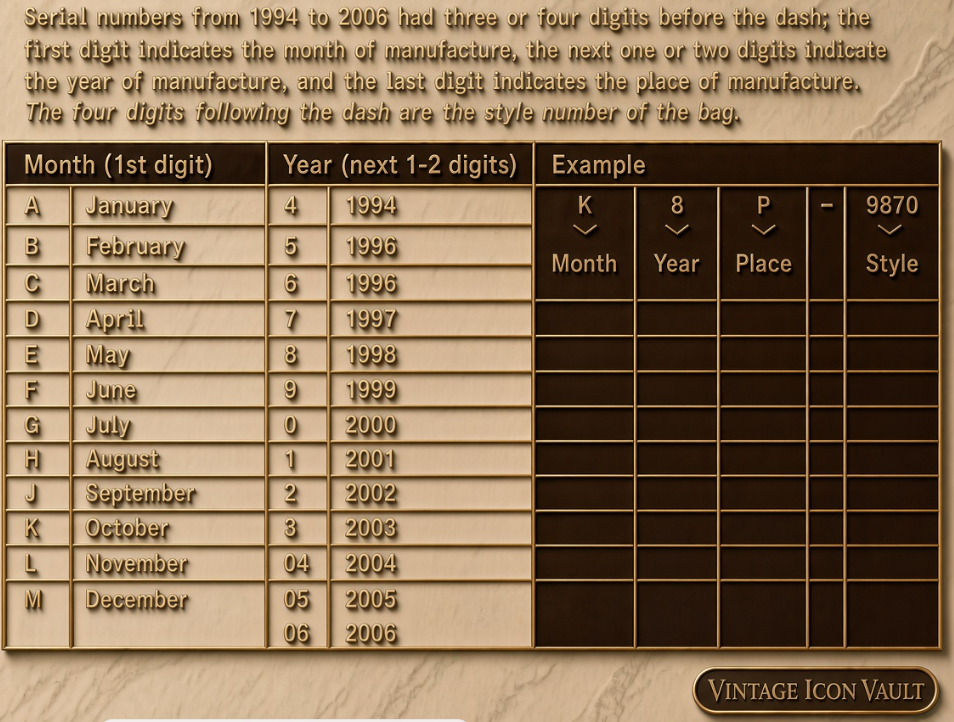
* Pictured Above: Coach Serial Creed Stamp Guide 1994 to 2006
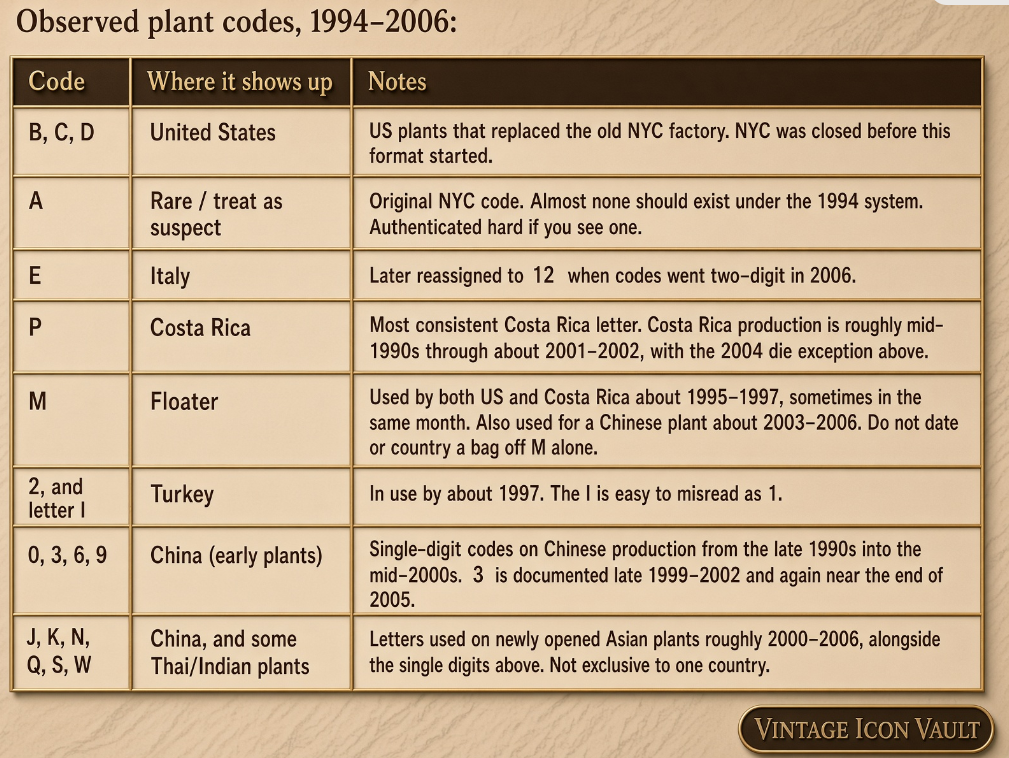
* Pictured Above: While Coach Never Published A key to its Plant Codes, These Are Well Documented Observed Plant Codes from 1994 - 2006.
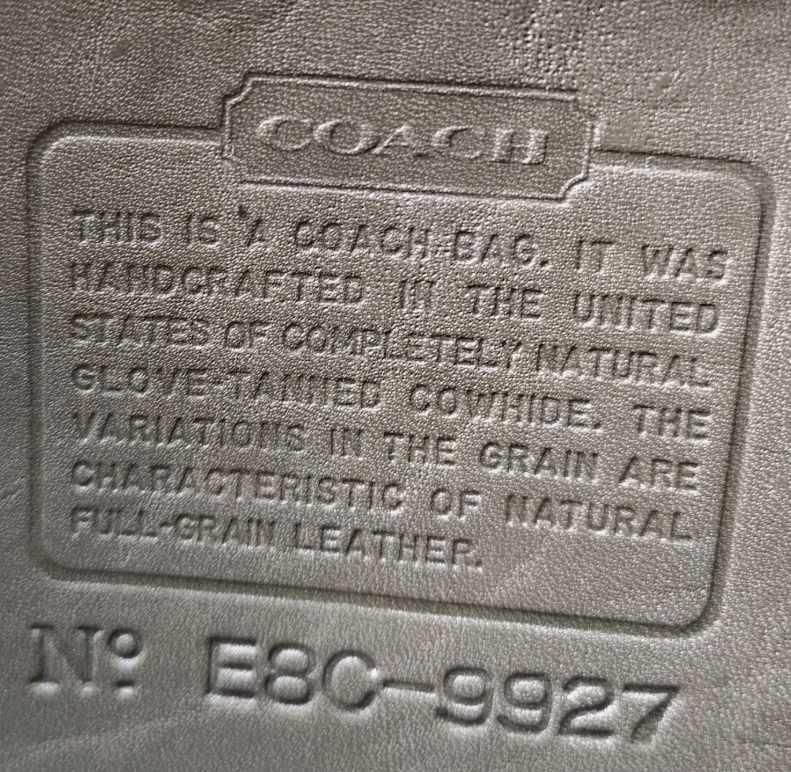
* Pictured Above: A May ("E") 1998 ("8") Willis Style ("9927") Bag Serial Creed.
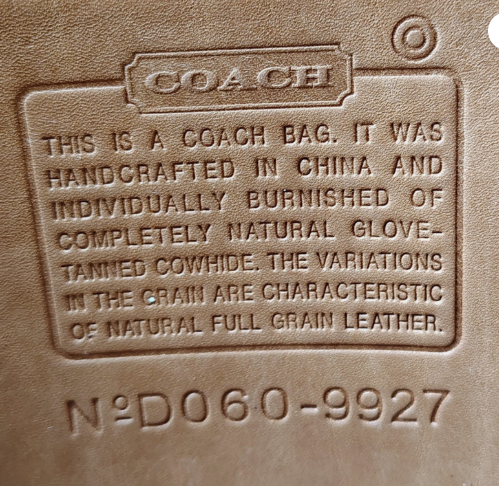
*Pictured Above: An April ("D") 2006 ("06") Willis Style ("9927") Bag Serial Creed.
2006 to 2014: FIVE DIGIT STYLE NUMBER AND TWO DIGIT PLANT CODE ON THE CREED
From 2006 to 2014 the Coach creed still dates the bag. The order does not change. It is month letter, year, plant, dash, style number, stamped under the paragraph on the sewn leather patch. The two-digit year is already in place from 2004, so a bag that reads 06, 08, or 12 is not a new system. It is the same system with a longer number.
Late 2006 is the length change. Style numbers go from four digits to five. Plant codes, already a letter or a single digit, expand to two characters. Four-digit styles still show up early in this window. They do not vanish overnight. If the bag is otherwise right, a four-digit style in 2006 or 2007 is not a problem by itself.
Month: The month letter is the same one used since 1994. A is January. B is February. C is March. D is April. E is May. F is June. G is July. H is August. I is skipped, because it reads as a 1, so J is September. K is October. L is November. M is December. I and N show up as known errors. Treat either one as a reason to look harder at the bag, not as a date.
Year: The year is the two digits after the month letter. 06 is 2006. 08 is 2008. 14 is 2014. That is the clean part of this window.
Plant: The plant field still has no official published key. Coach never issued one. The code can be a letter, a single digit, or two characters, and the same mark was reused and reassigned. Do not treat 69 as a country, a city, or a factory name. It is a plant mark. That is all the stamp proves.
Style: Everything after the dash is the style number. A five digit number after the "-" dash is the unique style code designation for the purse.
China is already in the manufacturing mix before this window opens. Creed wording follows the plant, not the year. This bag says it plain: “This is a Coach bag. It was handcrafted in China from the finest suede and leather. Its superior craftsmanship reflects our commitment to enduring quality.” That China line is not on every bag from 2006 to 2014. It appears when China is the origin. A bag made elsewhere in the same years carries a different origin line, or none.
The number after the dash is the style, not a unique serial. Two bags of the same style, made in the same plant in the same month, can carry the same stamp. Use 12797 to identify the model. Use the front half to place the bag in September 2008. If the style number points to a bag Coach was not making in 2008, the stamp and the bag do not agree. That disagreement is the useful test.
The stamp stays on the creed through this window, until summer 2014.
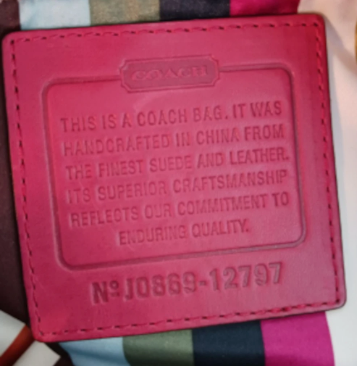
* Pictured Above: A Coach Haversack Style ("12797") made in October ("J)" 2008 ("08") in China (69)
2014 to EARLY 2016 (APPROX): THE CREED DOES NOT HAVE THE SERIAL AND A TAG WITH SERIAL IS SEWN INTO THE LINING
On many styles Coach stopped stamping the month/year/plant code on the creed. The creed patch itself became longer and more generic. The serial information is now on a small white label usually sewn into the inner zip pocket of the bag.
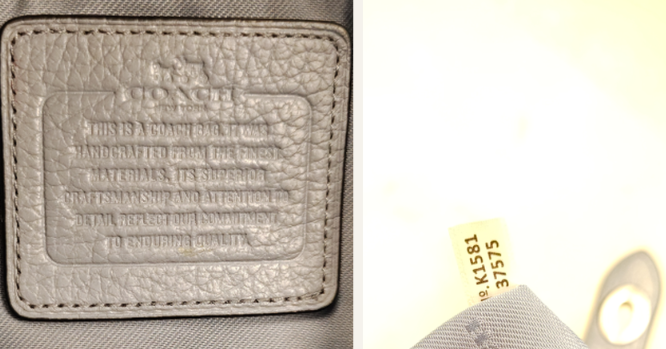
* Pictured Above: A Coach Mercer Bag ("37575") Made in October ("K") of 2015 ("15") in China.
2016 to 2020: SERIAL MONTH, YEAR, PLANT CODE AND STYLE BACK ON THE SEWN IN CREED
2016 is the year the code moved back onto that patch. Early 2016 bags often still have a blank creed, with the code on a small white woven tag tucked into a zip pocket or along a seam. From later 2016 through 2020, most bags have the code on the bottom line of the creed, often after “No.” A few still use the white tag, or both. A blank creed is normal only if that black and white tag is still sewn into the lining of the bag.
Month: The first letter is the month. Coach runs A through M and skips I. A is January, B February, C March, D April, E May, F June, G July, H August, J September, K October, L November, M December.
An “I” or an “N” in the month spot shows up as a known error on some real bags and is also common on fakes, so do not date the bag from either letter.
Year: The next two digits are the year. 16 is 2016, 17 is 2017, 18 is 2018, 19 is 2019, 20 is 2020.
Whatever is left before the dash is the plant. In this example that is 81. It can be a letter, one digit, or two digits. Coach reused these marks, and there is no public plant list, so it does not tell you the country.
Style: The number after the dash is the style. From 2016 to 2020 it is usually five digits. Search that number for the model name.
An “F” in front of the style number means the bag was made for the Coach factory outlet channel, and it can still be genuine Coach.
A “P” in front of the style number marks a pilot run.
A letter at the end of the style number can mark a store exclusive: M for Macy’s, B for Bloomingdale’s, E for Dillard’s.
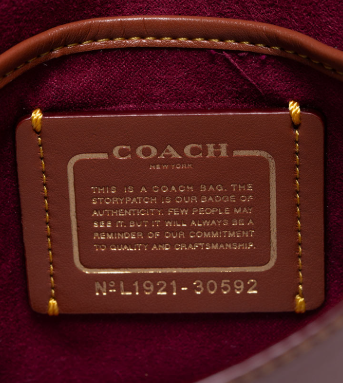
* Pictured above: a Coach Parker 18, style 30592, made in November (L) in 2019 (19) at plant 21. The plant location is not published. If the bag has a "made in" tag sewn inside the lining, that tag is what tells you the country.
2020 TO PRESENT: THE DATE CODE IS THE SAME, THE STYLE CODE CHANGES
Month: The first letter is the month. Coach runs A through M and skips I. A is January, B February, C March, D April, E May, F June, G July, H August, J September, K October, L November, M December.
The month runs A through M and skips I, so it cannot be read as a 1.
Year: The next two digits are the year. 20 is 2020. 25 is 2025, etc.
Plant: The last two digits are the plant. Coach has never published that map, and the codes get reassigned, so a plant number cannot be turned into a country.
Style number: After the dash there are four digits on models already in production before the change (6019). A post-2020 bag with no C is not automatically wrong.
Also you may see three digits only, on some short runs (601).
C plus four digits, once the plain numeric range was used up (C0769, C0772).
From about 2022, a second letter once that block filled: CA, CB, CC, through CW. Coach does not publish a key to the C / CA / CB / CW series. The letters are an internal series marker so old numbers could be reused. They are not factory, color, collection, retail, or outlet.
The F Style prefix Phase Out:
An F in front of the style number (F58312) meant made for Coach Factory outlet line. It was still on new issues into about 2020–2021. After that, new retail and outlet styles both use the C / CA / CW series.
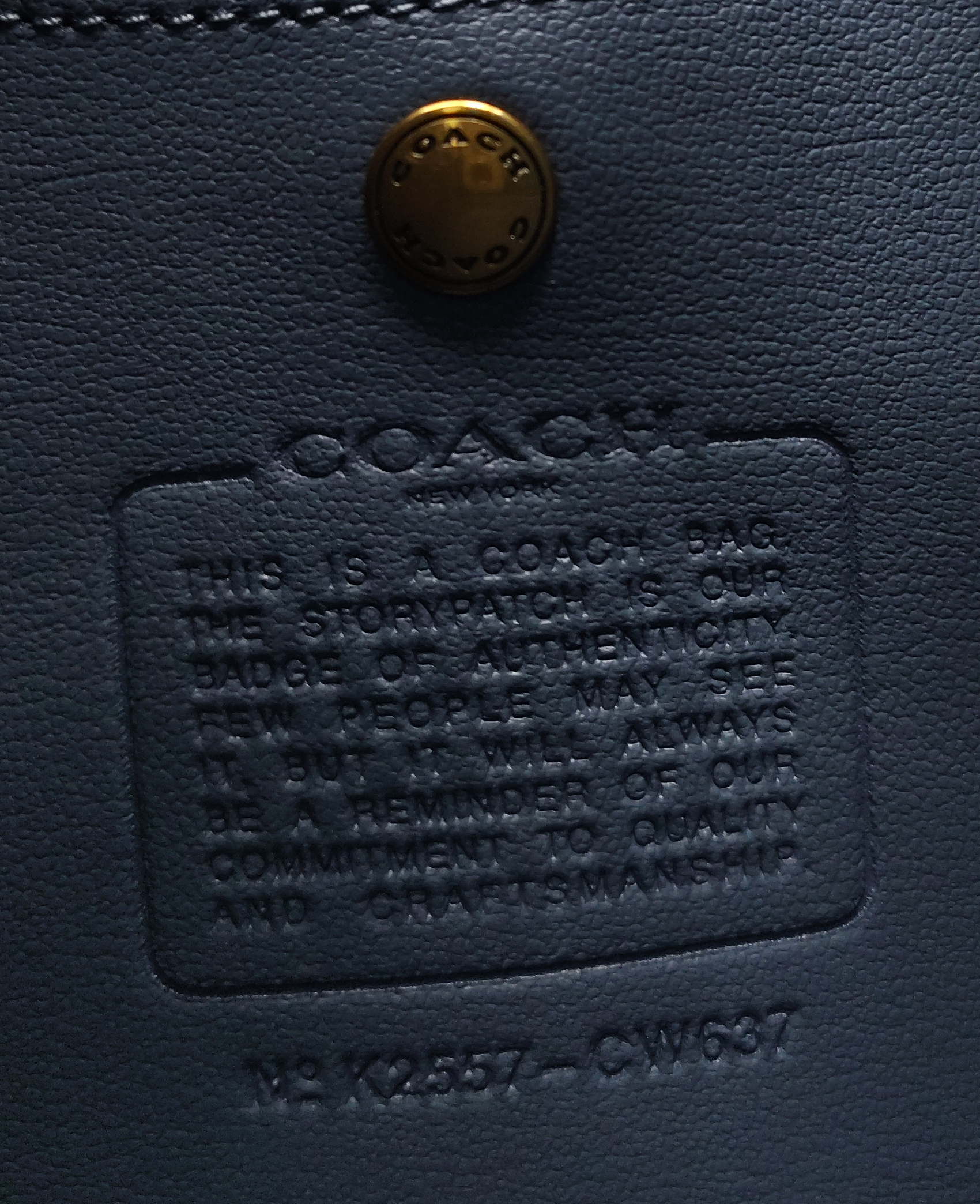
* Pictured above: a Coach Brooklyn 28 Hobo style CW637, made in October ("K") of 2025("25") at plant 57 (unknown country). The plant location is not published. If the bag has a "made in" tag sewn inside the lining, that tag is what tells you the country.
SPECIAL COACH 1941 COLLECTION (2015–PRESENT):
The Coach 1941 collection launched as a distinct, elevated line separate from the main Coach New York offering. It debuted on the runway at New York Fashion Week in September 2015 (the brand’s first official runway presentation, for Spring 2016) and reached retail in late February to early March 2016, timed with the 75th anniversary. Distribution was limited to flagships, select specialty retailers, and the brand’s site.
The line carried its own heritage-styled branding: dedicated Coach 1941 hangtags (often showing the horse-and-carriage with “1941”), matching dust bags, clochettes, and frequent “Coach 1941” markings on hardware, zipper pulls, or leather tabs/flaps. Interiors and construction emphasized thicker glovetanned leathers (commonly pebble) and suede linings on many pieces, setting them apart from core collections. Key early styles included the Rogue, Dinky, and Saddle.
On the earliest Rogue, Dinky, and Saddle pieces, the creed patch often carried model-letter codes instead of a conventional production serial and style number:
- RG for Rogue (commonly RG-20315)
- DK for Dinky (commonly DK-20215)
- SD for Saddle (commonly SD-20115)
These letters identify the model family only. They are not the style number and do not function as the usual month/year/plant code. The actual style number and production details appear on a small white fabric tag sewn inside, typically tucked into a zip pocket or corner. A few other early 1941 styles used similar model-letter prefixes (such as OT for Outlaw). After this short window the standard serial returned to the creed patch.
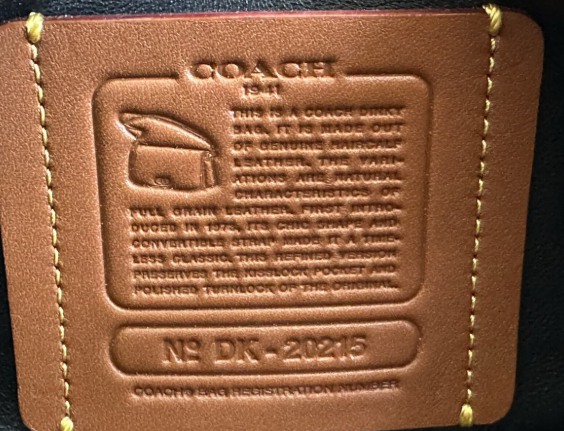
* Pictured above: a Coach 1941 Dinky DK-20215
Special Markings 1990s to 2010: Made for Factory (MFF) “F,” Bullseye, and “X” Marked Style Numbers and Factory-Store Bags
MFF-grade bags are sold through discount retailers (Marshalls, TJ Maxx, and similar), not full-price Coach boutiques or standard Coach Factory/Outlet stores. The MFF designation appears on or near the creed patch, separate from the serial number.
Related marks include:
- Bullet or target stamp = full-price boutique bag later diverted to outlet (FP delete).
- F after the dash in the style number = Made for Factory (outlet-only line).
- X or Z in the style number on the serial patch = MFF grade for a discount retailer such as TJ Maxx.
- M or N = boutique exclusives for Macy’s or Nordstrom.
- FS or double bullet = final sale (no returns or repairs).
An X stamp (sometimes accompanied by an “irregular” or “error” stamp) on the interior leather creed patch marks the bag as a factory/outlet piece or a marked-down final-sale item, rather than a standard full-price boutique release. An X near or on the creed typically indicates clearance through secondary or outlet channels. This differs from a circular bullseye or target stamp, which more often signals a factory second with a minor cosmetic flaw. An X stamp does not indicate a counterfeit; authentic Coach bags (vintage and modern) routinely carry factory or outlet modifier stamps on the creed.
Style numbers beginning with F on the creed or price tag identify bags made specifically for Coach Factory (outlet) stores. These are genuine Coach product, produced as a separate outlet-only line, often to different specifications from full-price (FP) boutique bags. Other prefixes exist for different channels (discount chains, department-store exclusives), but F designates the Coach Factory line.
Coach’s outlet channel began around 1990 with the opening of the first factory stores. Early outlets primarily sold full-price overstock, discontinued, and deleted merchandise rather than dedicated outlet product. Many of those bags received bullseye or X stamps to show they had been moved to outlet for clearance.
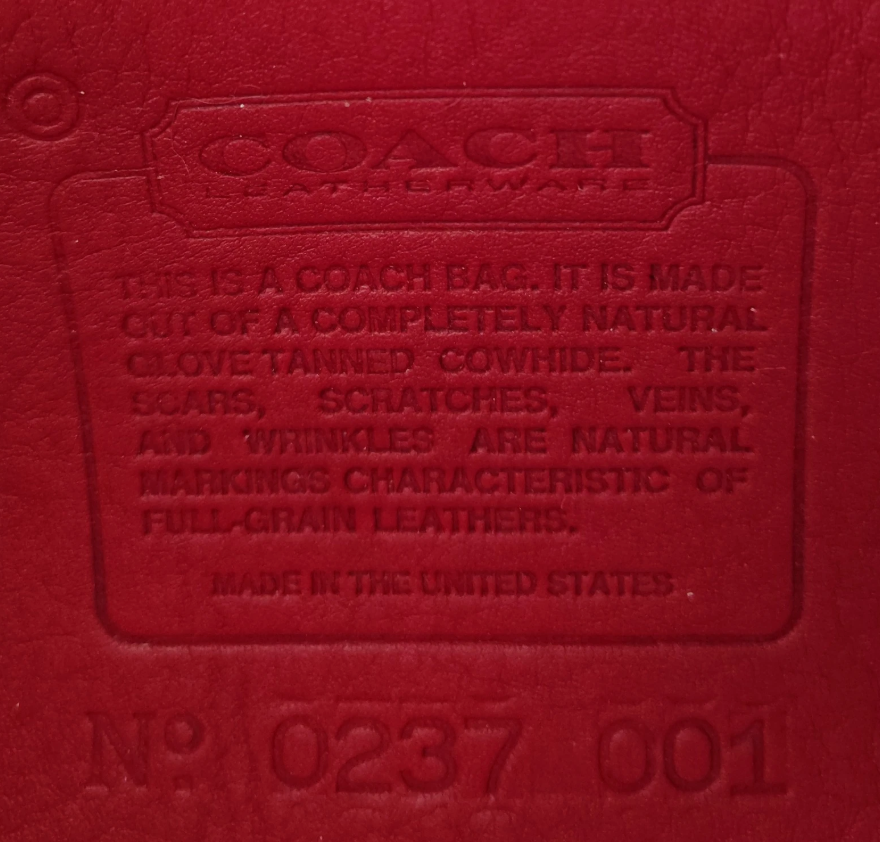
* Pictured Above: "Bullet" stamp in Upper Left on an early 90's Vintage Coach Bag which is a full price retail boutique bag later sold at a Coach outlet.
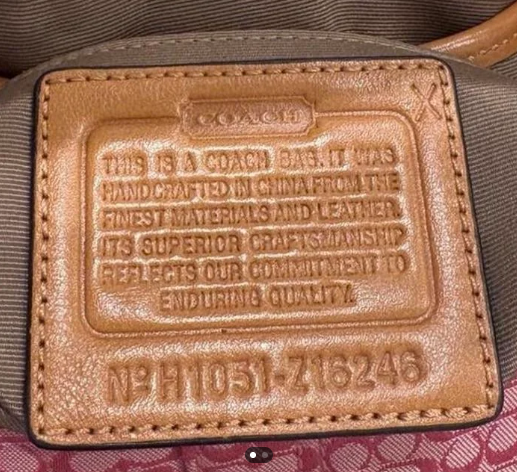
* Pictured above: A Coach Pink Signature C Soho Made in August ("H") in 2010 ("10") in China and made for TJ Maxx or Similar Discount Retailer
Sign in to leave a comment